Product Detail

General Introduction

The HACS (Hydrodynamic-Actualized Cell Sorter) is a general-purpose automated microfluidic sorting platform targeted at both basic life science research and clinical translational applications. The system exhibits broad compatibility with multiple sample types, including single cells, multicellular aggregates, organoids, and microspheres.

The integration of reusable microfluidic module lowers costs and eliminates disposable chip batch variability. With customizable parameters and fully automated process, it reduces human error and improves reproducibility for high-precision clinical and research use.
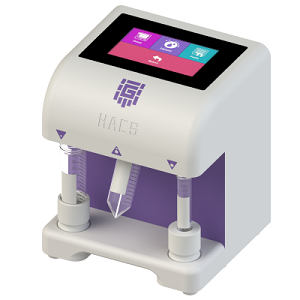
HACS  Device

Principle

Particles flowing through a microspiral channel experience two additional size-dependent forces: Dean drag and inertial lift. An inner-shallow, outer-deep channel design creates a bistable state: large particles focus on the inner wall (inertial lift dominant), small particles trap on the outer wall (Dean drag dominant). This enables purely hydrodynamic sorting of suspended particle samples.

The core sorting module μFCPU (Microfluidic Cell Processing Unit) is fabricated using our proprietary LMAC process. Constructed from highly stable materials, the module contains no irreversible modifications, allowing for long-term repeated use.
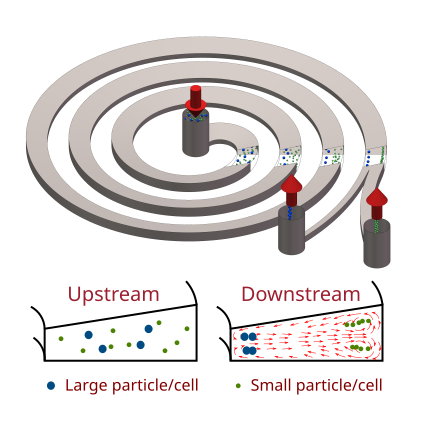
HACS  Principle

Advantages

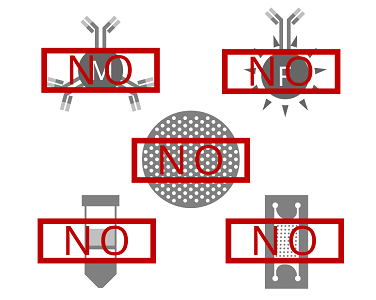
  • Label-free: No antibodies or magnetic beads, preserves cell function
  • 5–50 μm size range: Compatible with cells, clusters, and organoids
  • ≥99% cell viability: Gentle, non-damaging native sorting
  • High-throughput: 45 mL max sample volume, throughput up to 10⁷ cps
  • One-click automation: No specialized technical expertise required
  • Zero chip consumables: Superior consistency, lowest cost of ownership
Compare of HACS and others

Applications

  • Functions as a high-performance intact CTC enrichment platform that outperforms comparable commercial systems.
  • Purification and subtype sorting of stem cells, immune cells, and tumor cells from culture systems.
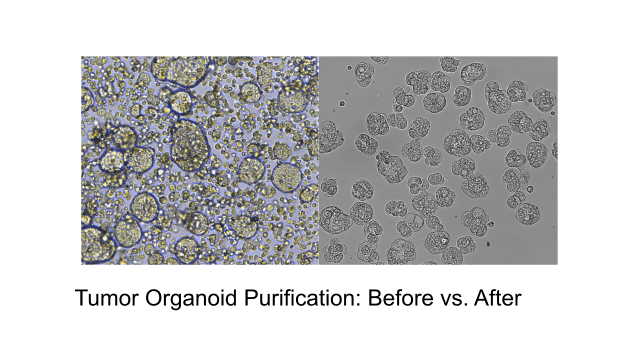
  • Standardized large-scale production of organoids for drug development and drug sensitivity testing.
  • Gentle blood leukocyte sorting (alternative to centrifugation/lysis).
  • Sorting and purification of other sample types including cell clusters, microspheres, and sperm cells.
HACS Application

Use Cases

  • Confirmed by post-sorting expansion and a series of experiments, large-diameter MSCs identified as osteoprogenitor cells with superior bone marrow repair efficacy, act as cell factories secreting high levels of regenerative factors.
  • Separation and recovery of polymorphonuclear leukocytes (PMNs) and mononuclear leukocytes (MNCs) with efficiency exceeding 80%. Unlike other methods, highly environmentally sensitive PMNs do not undergo artificial pseudo-activation compared to the original input samples.
  • In clinical samples from 10 patients with advanced metastatic breast cancer and lung cancer, this method achieved 100% detection and isolation of suspected CTCs.
HACS Representative

Publications

1. Guofeng Guan, Lidan Wu, Ali Asgar S. Bhagat, et al. Spiral microchannel with rectangular and trapezoidal cross-sections for size based particle separation. Sci Rep (2013). DOI: 10.1038/srep01475
2. Lidan Wu, Guofeng Guan, Han Wei Hou, et al. Separation of Leukocytes from Blood Using Spiral Channel with Trapezoid Cross-Section. Anal Chem (2012). DOI: 10.1021/ac302085y
3. Zhiyong Poon, Wong Cheng Lee, Guofeng Guan, et al. Bone Marrow Regeneration Promoted by Biophysically Sorted Osteoprogenitors From Mesenchymal Stromal Cells. Stem Cells Transl. Med (2015). DOI: 10.5966/sctm.2014-0154
4. Majid Ebrahimi Warkiani, Guofeng Guan, Khoo Bee Luan, et al. Slanted Spiral Microfluidics for the Ultra-fast, Label-free Isolation of Circulating Tumor Cells. Lab Chip (2014). DOI: 10.1039/c3lc50617g